Friday, July 08, 2011

Jeff Bridges -- The Dude Records

It's an old and usually horrendous game: a successful actor or actress takes a musical turn, believing that talent in one medium will automatically translate to talent in another. William Shatner and Scarlett Johansson, anyone?

So the Dude has made an album. A self-titled one on Blue Note Records, due out in the middle of August. Go figure. He's surrounded himself with top-notch talent -- T Bone Burnett in the producer's chair, the Joe Henry house band, Sam Phillips and Roseanne Cash on backing vocals. Predictably, the sonic pieces sound great. Less predictably, so does Jeff Bridges. Those of you who saw him in Crazy Heart probably aren't completely surprised by this. Bridges can do the grizzled, world-weary Country Dude about as well as anybody, even approaching hallowed Johnny Cash territory. What is more surprising to me is how well he does buoyant, swaggering country rock. Opener "What a Little Bit of Love Can Do" sounds like a bona fide hit, its jangly Buddy Holly riff scuffed up by Bridges' raspy vocals. But Bridges has that grey hair for a reason, and on the late Stephen Bruton's "Nothing Yet" he pulls off a harrowing tour-de-force, a deeply rueful stocktaking that barely rises above a whisper. It's a marvellous lesson in both soul and restraint, the verses made all the more powerful because you have to strain to hear them. It sounds like a deathbed confession.

In the end, it's a moot question as to whether Bridges has the musical goods. He sings well enough to be totally believable. It's a talent he's transferred over from his movie roles, and the Dude abides just fine in the recording studio. I'll have a more detailed review out in Christianity Today, but this one is a delightful, moving surprise.

Thursday, July 07, 2011

Fucked Up - David Comes to Life

First, I didn't name the band. Don't blame me.

Second, they're pretty good anyway. Given the name, what's surprising is not the feral howl of behemoth frontman Pink Eyes, but rather the prog rock shredder underpinnings of these 18 very long songs. This is melodic hardcore with hooks, and with at least a rudimentary knowledge of metaphor, character development, and lyrical nuance. Imagine.

I pretty much missed Fugazi and Black Flag, although those are some obvious touchstones. But so are Rush and Van Halen. Pink Eyes basically alternates between bellowing and screaming, with occasional bouts of ranting thrown in for good measure, but the female backing vocalists add some needed humanity. The press release assures me that this is a concept album about something or other (Love? Murder? Vengeance? George Bush? Astral projection? I think they're all in there somewhere), but I wouldn't worry too much about it. Much like last year's album The Monitor from Titus Andronicus, this is a whole lot of blustering noise and literary pretense, probably all deeply indebted to weed. What matters are the guitar riffs, and they are unsurprisingly fierce and surprisingly nuanced and dynamic. This is a punk band that can really play, and they've certainly released my favorite Rawk album so far this year.

Saturday, July 02, 2011

The Second Tier?

More and more I'm convinced that the mid-'50s through the mid-'60s were the true Golden Age of Jazz. Not only were the acknowledged giants roaming the earth and laying down their masterpieces -- Miles, Trane, Mingus, Monk, Bill Evans, Sonny Rollins -- but there were a whole host of "second-tier" musicians who released one stellar album after another. God only knows why these folks aren't better known, but they're not. I'd argue that there's at least a couple albums from each of these relative unknowns that can hold their own with the greatest jazz ever released.

And so this morning I've been sampling the wares of a few longtime favorites who frequently get pushed aside (at least by me) in favor of their better-known contemporaries. Specifically, I've been listening to:

Sonny Stitt -- Stitt Plays Bird
Booker Ervin -- Cookin'
Dexter Gordon -- Go
Eric Dolphy -- Out to Lunch
Hank Mobley -- Soul Station
Horace Silver -- Blowin' the Blues Away
Jackie McLean -- Right Now
Jimmy Smith -- The Sermon
Lee Morgan -- The Sidewinder
Rahsaan Roland Kirk -- Domino
Stan Getz and Joao Gilbert -- Getz/Gilberto
Sun Ra -- Sun Ra Visits Planet Earth

Every one's a masterpiece, I'm telling you. There's hundreds more where those came from.

Thursday, June 30, 2011

The Happy Thoughts - The Happy Thoughts

You can generally figure that a band called The Happy Thoughts is either being ironic or terminally retro. In this case, retro wins. But I'm very impressed with these straightforward Buddy Holly/Bobby Fuller homages. There's no irony here, but there's plenty of jangly '65 rock 'n roll. There's a song about Indiana girls called, wait for it, "Indiana Girls," in which lead singer/songwriter Eric LaGrange opines:

I've been west and I've been east
And there's lots of real nice girls to see
They've got curves and they've got curls
But it's a lot more fun with Indiana girls

They just don't write 'em like that anymore. And yeah, it's a note-for-note knockoff of Fuller's "I Fought the Law (and the Law Won)," but if it was good enough for The Clash, it's good enough for me, too. There are about a dozen more inconsequential, delightful songs just like it, each of them running about 2:30. It's a ridiculously great summer pop album.

Friday, June 24, 2011

Gillian Welch

This Depression-era waif is Gillian Welch -- in reality a modern-day SoCal child of privilege who dresses up in vintage dresses and pulls her hair back severely and tries to look and sound like Mother Maybelle Carter. It's okay. She writes songs that would sound marvelous in 1930 or 2030, and she and musical sidekick/life partner David Rawlings harmonize better than any of the country hippies since Gram Parsons and Emmylou Harris.

She has a new album out on Tuesday, The Harrow and the Harvest, her first in eight years. I'm pretty excited about it, not only because it's been a long time in coming, but because it is, by all accounts, a return to the Appalachian roots of her early albums, which featured poetic songwriting, an acoustic guitar, a dobro, and an occasional clawhammer banjo, and two voices soaring together.

She's a great songwriter, a master of stark minimalism who says more with less than any of her peers. Here's one of my favorite hymns, where she distills the essence of sin and redemption down to about 50 words.


Nobody knows what waits ahead
Beyond the earth and sky
Li-da-li-da-li, I'm not afraid to die

And all the work of my own hands
Be broken by and by
Li-da-li-da-li, I'm not afraid to die

Sometimes it finds me fast asleep
And wakes me where I lie
Li-da-li-da-li, I'm not afraid to die

Forget my sins upon the wind
My hobo soul will rise
Li-da-li-da-li, I'm not afraid to die

I need to hear the new album, but I'm predisposed to think highly of it. You should check her out if you haven't done so.

Monday, June 20, 2011

Remembering the Big Man

The media and the people who care about demographics would tell you that I belong to the tail end of the Baby Boomer generation, the folks who brought you Woodstock and Vietnam War protests, free love and costly debt accumulation. I would tell you that I belong to Bruce Springsteen and the E Street Band. It’s woefully inadequate as a tagline for an identity. But as a handy encapsulation of the forces that shaped my life, it will do. By the time I became old enough to care about cultural tags, the hippies had faded, the Vietnam War was winding down, Nixon had resigned, and Ford and Carter were presiding over a nationwide malaise. I was part of the generation that didn’t have a name. We weren’t Baby Boomers. We weren’t anything, really. We were just young, idealistic kids. In my case, I was trying to follow Jesus and trying to figure out how He would help me find a job once I graduated.

Bruce Springsteen played a concert in Athens, Ohio at that time, at a little auditorium on the campus of Ohio University. I was maybe 50 feet from the stage. And Bruce Springsteen did what he always did. He played for three and a half hours, and nobody, and I mean nobody, was complaining about the length of the show. I emerged a full-fledged, sweat-soaked, exhausted believer. Bruce got it. He understood in ways that the hippies totally missed. He understood the passions and the frustrations of my nameless generation, and he captured it all in mythic metaphors and poetry that could sing and sting. He also happened to play epic, glorious rock ‘n roll. “Every generation throws a hero up the pop charts,” Paul Simon would sing a decade later. Bruce Springsteen was mine. I just happened to share him with a few million other people.

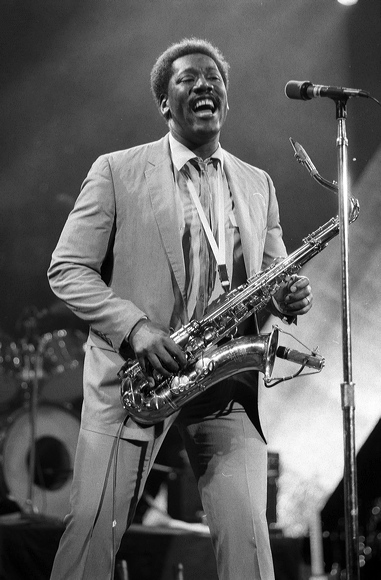
The big black man who played saxophone at that concert died this weekend. His name was Clarence Clemons, although to millions of Springsteen fans he was simply The Big Man. Clarence Clemons wasn’t a great sax player. There are dozens of jazzmen who could school him. And he only really played two great solos in his life. The rest of the time he was content to churn out standard R&B riffs. Don’t let that fool you. He was the heart and soul of the E Street Band, and the E Street Band was the rock ‘n roll band of that nameless generation. Nobody else even came close.

Those two solos are both on the album Born to Run, the album that defined Bruce Springsteen. The first one is on the title track, a mad, soaring slab of soulful exuberance that perfectly matched the grit and passion of the lyrics. “We gotta get out while we’re young,” Bruce Springsteen sang, and that’s what Clarence Clemons played. It was a sax solo for the open road, for busting out and breaking shackles. The second and greater solo occurs at the end of the album, on a song called “Jungleland.” The open road has somehow inexplicably wandered into a thicket of blind alleys. The narrator who set out so confidently on the journey is back on the dead-end streets. Midway through the song Clarence Clemons plays a two-minute solo that captures the sound of America circa 1975, of the nameless generation of kids who thought they might have a defining moment, but didn’t, who busted out only to find a roadblock, a wall, an asphalt jungle without signs or markers. It is a solo that starts with a sustained wail and ends with a whimper. It may be the greatest rock ‘n roll elegy ever captured on recorded media.

That’s the guy who died this weekend. Maybe you had to be there, in Athens, Ohio, on that April night in the mid-1970s. Maybe you simply need to listen to the music. But that’s what we lost. And so it was a strange, rollercoaster day yesterday – Father’s Day, a day where I had wonderful conversations with my wife, and my kids, and numerous friends, and where I found myself emotionally raw, the tears welling up at the strangest times and the most inconvenient moments. The day was great. And so is the loss.

Wednesday, May 25, 2011

David Bazan - Strange Negotiations

My review of the new David Bazan album Strange Negotiations, at Paste.

Tuesday, May 24, 2011

Dylan at 75

New York, NY -- Feb. 17, 2016

Bob Dylan's 115th studio album It Doesn't Feeeeel At All Anymore will be released to coincide with the venerable musician's 75th birthday, on May 24th, 2016. Mr. Dylan, now confined to his nursing home bed except for seventy to eighty smoke breaks during the day, recorded the album over the course of several months last summer and fall. The unique circumstances of the recording sessions (e.g., the need to stop for oxygen intake roughly every thirty seconds) contributed to what longtime Dylan apologist Clinton Heylin refers to as the "breathless" quality of the music. "He can barely mumble anymore," Heylin says, "and when he's got a bit of oxygen in him, he tries to squeeze in as many words as he can. It's almost impossible to understand him, very much like the amphetamine-fueled days of the '66 tour." The twelve tracks, split between eight covers and four original compositions, reflect Dylan's ongoing obsessions with mortality, spirituality, and young women.

Track List

1. Hand Me Down My Walking Cane
2. Don't Get Around Much Anymore
3. Positively Mayo Clinic*
4. It Was a Very Good Year
5. Bad Girls
6. Bingo With a Bimbo*
7. My Generation
8. The Way We Were
9. Silver Threads Among the Gold
10. Idiot Anesthesiologist*
11. Hey Nineteen
12. Last Night I Dreamed of an Erection*

* = New Dylan composition

Dylan at 70

So it’s been five years since I did this. And now Bob Dylan is 70, an unseemly age at which rock ‘n rollers need to seriously consider a future involving adult diapers and pureed food. “How terribly strange to be 70,” Paul Simon once sang, and he was right. He’s only got a couple months to go now, too. You keep waking up in the morning, and before you know it, it happens.

In the intervening five years Bob Dylan has, with characteristic implausibility, released a lot of music. Some of it is old (the historic Newport Folk Festival recordings from ’63 to ’65, the superb collection of outtakes and alternate song versions called Tell Tale Signs, the oft-bootlegged Witmark Demos, and a ’63 concert recording from Brandeis University). Some of it is new (the ridiculously great Modern Times, the mediocre Together Through Life, and the merely ridiculous Christmas in the Heart).

He’s kind of set in his ways now, so you get the feeling that the utter unpredictability of the man and his work is probably not going to change. He is, without a doubt, the greatest songwriter and the single greatest presence in the history of what could loosely be construed as rock ‘n roll. But the fact is that rock ‘n roll has never been big enough to encompass what this man does, which ranges from Delta blues to hallucinatory poetry to honky-tonk jukebox anthems to gentle folk to schmaltzy MOR, complete with sappy strings and heavenly host choir accompaniment. And that’s just in the last five years.

At some point he will probably stop making music. But he’ll go out with his boots on and his harmonica rack strapped to his guitar, and the Neverending Tour will have to be cancelled due to unforeseen circumstances. I hope that’s a long, long way off. Happy birthday, Bob. His biography at All Music Guide starts off with “Bob Dylan’s influence on popular music is incalculable.” That’s correct, and I won’t even begin to try to tote it up. But I’ll still marvel at what the man has done, and is doing. He won’t care about that, or about anything else written or said about him. He will go on being Bob Dylan. I suspect that’s part of the reason why we love him.

Monday, May 23, 2011

Friday, May 20, 2011

Every Picture Tells a Story

Forty years ago this week Every Picture Tells a Story arrived on American shores. It was Rod Stewart’s third solo album, but nobody was really counting at the time. That’s because Rod Stewart was everywhere in 1971, and his albums with his superb band Faces were rivaling those of The Rolling Stones as the best that rock ‘n roll could offer.

For anyone who knows Rod Stewart only from his cheesy pop ballads (“Tonight’s the Night,” “Do Ya Think I’m Sexy?”) and his incessantly bland covers of the songs of Cole Porter, Irving Berlin, and George Gershwin, it may come as something of a shock to know that at one point he was the greatest rock ‘n roll singer in the world. But he was. He proved it on this album, where he took a bunch of old and decidedly placid folk, country, and R&B songs, and simply rocked the shit out of them. The fact that he did this with fiddles, pedal steel, acoustic guitars, and mandolins as lead instruments (and, okay, the world’s most primitive drummer in Micky Waller) is all the more remarkable.

There are a few exemplary Stewart originals here – “Mandolin Wind,” the title track, and, of course, “Maggie May.” But it’s the covers that still astound me. Whether obscure (Ted Anderson, anyone?) or blazingly obvious (Bob Dylan, Elvis, The Temptations), Rod’s covers on this album remain the definitive versions of these songs. There are eight songs here, spread out over about forty-five minutes. Okay, so Rod had yet to figure out how to write a catchy three-minute single (and I, for one, am never going to forgive him “Do Ya Think I’m Sexy?,” in spite of its admirable brevity). So he left a lot of room for the band to jam. Good thing, too, or we would have never heard Ronnie Wood’s finest six minutes as a guitarist on the title track, or Lindisfarne’s Ray Jackson play those poignant mandolin codas on “Maggie May” or “Mandolin Wind.” What we have here is as close to a perfect album as the seventies produced. If you’ve never heard it, do yourself a favor and discover one of the classics.

Wednesday, May 11, 2011

Nelsonville Music Fest, 2011

Nelsonville, Ohio doesn't have much going for it. There used to be a shoe factory in town, but it closed up shop a long time ago. Now 10,000 people hang out and don't do much of anything. There isn't much w0rk outside of the fast-food restaurants and gas stations. The more enterprising citizens run meth labs out on the Back 40, and there's plenty of open spaces right outside of town to raise illegal cash crops to sell to the college kids in Athens, 15 miles down the road. And that's about it.

Or was about it, until about ten years ago. That's when a couple idealistic entrepreneurs bought an old, abandoned opera house in the center of town, refurbished it, and started bringing in national music acts. People trekked down from Columbus, 60 miles north. People trekked up from Athens, 15 miles south. It's not exactly a rags-to-riches story, but they made enough cash to do something truly audacious: start a major music festival out in the middle of nowhere, in the Appalachian foothills where nobody with any sense ever stops.

That was seven years ago. And it's taken off, sort of. By that I mean the musical acts have gotten bigger, the scope has gotten grander, and the three days in mid-May that it all goes down are the musical highlight of the year for quite a few people. But this isn't Bonnaroo or Coachella, where you can watch your favorite band from half a mile away. This is Nelsonville, Ohio, where 5,000 people show up, maybe 10,000 if the weather is nice, where you can cozy right up to the stage, and where you're liable to run into Willie Nelson or Loretta Lynn strolling the grounds. For some of us, it's just about the best music event in the world.

It's happening again, starting Friday afternoon and extending through Sunday evening. That's Sharon Jones and her Dap Kings up there to the left, who put on one hell of a show last year. Sharon won't be there this year, but here's who'll show up:

FLAMING LIPS
GEORGE JONES
NEKO CASE
Yo La Tengo
Wanda Jackson
Justin Townes Earle
Over The Rhine
Ghost of a Saber Tooth Tiger
Lost in the Trees
Bomba Estereo
Mucca Pazza
The Growlers
Michael Hurley
Drakkar Sauna
Doug Paisley
Ned Oldham & Old Calf
Baby Dee
Y La Bamba
Cheyenne Marie Mize
Southeast Engine
The Honeycutters
Chooglin'
Samantha Crain
The Spikedrivers
Sgt. Dunbar & The Hobo Banned
Nick Tolford and Co.
Mount Carmel
Wheels On Fire
Black Owls
She Bears
The Black Swans
Hex Net
Octopus & Owl
Duke Junior + The Smokey Boots
Scubadog
Whale Zombie
Weedghost
Rattletrap
Jerry DeCicca
Eve Searls
Shelby Carter
Jess & Kyle
Zeb Dewar
Bruce Dalzell
Todd Burge
Chris Biester
Matt Moore
The Lovesick Blues
Seth Riddlebarger
Bill Wagner & Brett Burleson
Shazzbots
Flyaway Saturn
Elemental Revolver

That deck is stacked, but clearly the aces are on top. Most people will come for The Flaming Lips, and that's fine. If it brings people to Nelsonville, Ohio, I'm for it. Personally, I'm most excited about George Jones (who will, I trust, show up) and Neko Case. I look forward to seeing rockabilly queen Wanda Jackson and indie stalwarts Yo La Tengo for the first time, and Justin Townes Earle and Over the Rhine for the umpteenth time. Some of those folks farther down the list make me pretty happy, too. Michael Hurley is a freak-folk original, a guy who's been writing wonderful and bizarre songs since the '60s. Drakkar Sauna recorded an album of Louvin Brothers covers a few years back that I thought was just swell. Doug Paisley is a Nashville renegage who writes literate, thoughtful, and wryly humorous country songs. I've already told my kids we need to get on the road early Saturday so we can catch Baby Dee. Baby Dee used to be a he, is now a she, and writes some of the most transparently beautiful piano ballads you will ever hear. My longtime buddies and Athens favorites Southeast Engine are playing Saturday afternoon, right on the heels of their new album that has received ecstatic reviews almost everywhere. I can't wait to see them. Jerry DeCicca and his fine Columbus country-noir band Black Swans are playing separately and together. Eve Searls, who I've only encountered in her fine band Super Desserts, is apparently playing a solo set. Oklahoma singer/songwriter Samantha Crain, whose 2009 album Songs in the Night knocked me flat, is playing a solo set. And my buddy Professor Josh Antonuccio, who doubles as an extraordinary music producer, is playing with his band Scubadog.

There is so much to see and hear. Couple that with anticipated reunions with lots of friends I haven't seen in a while, and a chance to spend three days with my daughters, both back home, albeit momentarily, from farflung universities, and you have the makings of one fine extended weekend. I suppose it's also worth mentioning that this is the biggest bargain in the music world. Three days of non-stop music will set you back a whopping $70. You should come. You won't regret it.

Monday, May 09, 2011

Okkervil River -- I Am Very Far

Here's my Paste review of the new Okkervil River album I Am Very Far, one of the highlights of this still-young musical year.

Tuesday, May 03, 2011

Poems, Never Read

Butcher knives and flowers. Poems, Never Read, at the Image Journal.

Monday, May 02, 2011

The Kick in the Crotch

My immediate reaction when I heard the news this morning was relief. Good. Good riddance. And I still believe that. But I didn't, and don't, feel like celebrating. Within about fifteen seconds my mind had turned to thoughts of, "Hmm, I wonder where the terrorists will strike next?" Because they will. We destroyed the figurehead of an insidious movement, but we have not destroyed the movement. And all the gloating, all the flag-waving, will do nothing but further incite people who are bent on hating and destroying us.

I posted some MLK and biblical quotes on Facebook today not because I wanted to be preachy and santimonious, but because I actually believe them. I think Jesus' teaching about these issues is fairly clear, and I try to take those teachings seriously. I certainly understand that there is a lot of room for differing views here, but what I don't understand is how Christians can condone and celebrate a spirit of vengeance, and how they can justify and gloat about the use of, for example, waterboarding, which apparently led to some of the information that resulted in bin Laden's demise. I guess the ends really do justify the means. I'm not sure where I read that, but I don't think it was the Bible.

There is much that I find dispiriting, unseemly, and distasteful about the events of the past 24 hours. Celebration is fairly far from my mind. So good riddance. But let's not pretend that there's anything remotely Christian about these proceedings. I know, it's a fallen world, and idealism gets kicked in the crotch every time. But don't ask me to cheer the kick in the crotch.

Tuesday, April 26, 2011

Both Girls Hoax Revealed

I have been listening to the self-titled album from Both Girls. It's a fine electronica/folkie kind of album, with surprisingly literate lyrics for people who play around with synthesizers. And there's a song about Ohio. You should buy it, and you can do so right here.

But something puzzled me all along, left me uneasy, staring up at the ceiling at 3:00 a.m., trying to unravel the mystery. There was a certain hint of je ne sais quoi in the vocal timbre that simply didn't jive with the title. Now, these are lovely girls, but they have surprisingly deep voices. And I became suspicious.

After several weeks of sleuthing, careful analysis of vocal tics, painstakingly meticulous reseach into the lowest limits that the female voice can reach, and Google searches on the term "Both Girls," I can now reveal the shocking truth. Both girls are ... well, you be the judge. Take a look at this:


I know, the evidence is circumstantial at best. These are half faces. They could be anybody. But they are most emphatically not girls. Not even bearded women can grow hair like that dude on the right. And although the fuzzy down on that "girl" on the left could theoretically be grown by a woman, "she" just doesn't look like a girl, does she?

So enjoy the album. It's a good one. But I thought it proper to warn you so you're not taken in by this hoax. Both Girls, my ass.

Steve Earle -- I'll Never Get Out of This World Alive

My review of Steve Earle's latest album at Christianity Today.

Monday, April 25, 2011

Glasvegas -- Euphoric Heartbreak

Glasvegas' sophomore album Euphoric Heartbreak falls victim to all the sophomore slump stereotypes. Bigger budgets mean more studio tricks, popularity leads to self-importance, and all the good songs got used up the first time. It's rarely a good formula, and it isn't this time, either.

The self-titled debut revealed a hungry Glasgow band that played to its strengths -- big, earnest anthems about grinding poverty, single-parent families, social workers, pints, skirts, and gang warfare. It was the world the band knew, and they put it across with buzzing Jesus and Mary Chain guitars and a singer who could out-emote Bono. For Euphoric Heartbreak they've hired U2 mastermind Flood to handle the production duties, and Flood does what he does, slathering on the synths, playing tricks with reverb, and generally smothering everything that made the band special in the first place. Just as problematic is lead singer/songwriter James Allan's newfound tendency to replace what he knows with Generic Uplifting Anthems. One is called "The World Is Yours." One is called "You," which features the stirring chorus of "You, You, You." One is called "Shine Like Stars," where James assures us that "Yesterday all my happiness seemed so far away/Now it looks as though it's here to stay." One hopes that Paul McCartney is feeling charitable. Then there's the puzzling "Lots Sometimes," during which Allan repeats the title mantra (I think about you lots sometimes/I wonder if you ever loved me at all lots sometimes) some thirty or forty times. That's lots and lots and lots. Too much, particularly for a phrase that is awkward from the start.

It's all deeply disappointing. To his credit, Allan still has those wall-rattling vocal chords, and he still declaims in a thick Scots brogue that mercifully obscures many of the more wince-inducing lyrics. But the frothy bombast of Euphoric Heartbreak is a major misstep. There is heartbreak here, all right, but precious little euphoria that doesn't seem forced and artificial.

Friday, April 22, 2011

Forty Odd Years

Finally, Loudon gets his own boxed set -- Forty Odd Years, 5 discs and 87 tracks, out in May. It's about time. Better known these days as the father of Rufus and Martha, Loudon Wainwright III has simply compiled one of the great, underappreciated catalogs in contemporary music. I've written about him before. I'm sure I'll write about him again. That's because he never fails to astonish me in his ability to peel back the layers of propriety and respectability and say the things that really go on in human relationships. This isn't warts-'n-all songwriting. Hell, this is probing the cancer at the heart of families, and putting the malignant cells under the microscope. God bless him and his dysfunctional life.

Last week I attended a family affair
And a few remarked upon my recent growth of facial hair
You look just like your father did
With that beard someone said
I answered back I am him
Even though my old man's dead
I didn't want to be him
Well at first I did
When I loved & looked up to him
As a little kid

He sent me to his old school
I was a numeral with his name
And he gave me this gold signet ring
And he wore one just the same

And I guess that I believed him
And probably it was true
When he told me I was just like him
That's what some fathers do

But a father's always older
And my dad was rather tall
Who says size doesn't matter
He was big & I was small

I needed to be big enough
To be someone someday
And I learned I had to beat him
And that was the only way

I learned I had to fight him
My own flesh blood bone & kin
But I felt I was just like him
Can a man's son be his twin?

First we fought for my mother
That afforded little joy
When he left she was heart broken
And I was still their little boy
But I started to get bigger
And to win the ugly game
When I made a little money
And I got a bit of fame

And I saw how this could wound him
Yes this could do the trick
And if I made it big enough
I could kill him off quick
But how can you murder someone
In a way that they don't die?
I didn't want to kill him
That would be suicide


I got frightened so I backed off
I let up and I was through
And in the end he did himself in
Usually that's what we do

I'm alive and he is dead
And neither of us won
It's spoiled for the victor
Once the vanquishing is done
A man becomes immortal
Through his daughter or his son
But when he fears his legacy
A man can come undone

And the beard is a reminder
I'm a living part of him
Although my father's dead and gone
I'm his surviving twin