Saturday, December 14, 2013

Favorites of 2013


Okay, ten, in no particular order other than alphabetical, because the idea of ranking the big band music of Darcy James Argue ahead of or behind the honky tonk stomp of Vince Gill and Paul Franklin is frankly ludicrous. And my favorite album of 2013 is not listed alphabetically because it’s the best. So there.

Every album here has a couple flaws. I heard no 5-star efforts this year, which is a little unusual. But, as is the case every year, there were many albums that thrilled me, moved me, made me sad, made me want to jump on the couch cushions and play air guitar (not recommended; just ask my wife), and made me very, very thankful. Here are the albums I loved the most.

Aoife  O’Donovan – Fossils

O’Donovan is the lead singer/songwriter for Crooked Still, an alt-country band that has impressed me up to this point only with their wild inconsistency. But on her first solo album, she blurs the lines between Americana and Celtic music, the accordions nestled up against the pedal steel, and delivers ten finely observed and beautifully sung ruminations on love and loss.

Darcy James Argue’s Secret Society – Brooklyn Babylon

Working with an 18-piece big band, Argue delivers another slab of steampunk jazz. Or something. Good luck finding a label. There’s an electric guitarist here who thinks he’s Jimi Hendrix. There are tight horn arrangements here that yield to avant-garde squonking and squealing. There are snatches of old Croatian folk songs, The Art Ensemble of Chicago, Count Basie on Saturn. Whatever this is, it’s bracing, startling, and often lovely.

Jonathan Wilson – Fanfare

Take every early ‘70s album you’ve ever heard and put it in the musical blender. Wilson’s lyrical approach is primarily drawn from the introspective, stoned navel gazing of 1971 Laurel Canyon. Think Jackson Browne, Joni Mitchell, and Crosby, Stills, and Nash. But sonically, this album features Pink Floyd spacerock, winding, jagged Neil Young/Crazy Horse guitar workouts, epic ELO pop orchestration, sophisticated Steely Dan jazz rock. It’s a sprawling mess; nearly 80 minutes of “Look ma, I can compress the ‘70s into one album.” The astonishing fact is that he does it.

Mikal Cronin – MCII

The garage rocker cleans up the scuzz, discovers production, melody, hooks, and choruses, and delivers the best power pop album of 2013. There’s still a delightful garage rock rawness about the proceedings, but Cronin makes the most of his three chords and ends up with that rarest of albums; 38 minutes of infectious rock ‘n roll without a second wasted.

North Mississippi Allstars – World Boogie is Coming

Delta blues and southern rock ‘n roll. That’s it. There will be the inevitable comparisons to the White Stripes and the Black Keys because of the minimalist lineup, and because Luther Dickinson is a genuine guitar hero, but in truth these tunes owe more to R.L. Burnside and Muddy Waters than the Rust Belt boys. This stuff just roars and stomps. If you’re looking for subtlety, go elsewhere. But, as Sam Phillips (the producer, not the female singer/songwriter) once said, this is where the soul of man never dies. It’s alive and well in North Mississippi.

Over the Rhine – Meet Me at the Edge of the World

Place gets short shrift in most contemporary music. The usual pop hit could emanate from anywhere. But imagine the music of The Beach Boys without southern California, or the music of Bruce Springsteen without the Jersey Shore. Place, for husband-and-wife team Linford Detweiler and Karin Bergquist, is a farm in southwest Ohio, and these lovely songs have dirt under their fingernails. This is incarnational music in the best sense. It’s rooted in time and place. It’s about real people with bodies. The love songs, which are here in force, are earthbound. Nevertheless, they soar.

Son Lux – Lanterns

Ryan Lott, the restlessly creative spirit behind Son Lux, has always been a musical alchemist, mixing the most seemingly disparate materials together; hip-hop beats and samples from Maria Callas, industrial clanging and what sounds like Rachmaninoff piano sturm und drang. The creative alchemy is still very much in evidence, but “Lanterns,” Lott’s third album, is more rooted in traditional song structures, and “Lost it to Trying” actually sounds like it could be a massive club hit. It’s an impressive pop move for a mad scientist.

Superchunk – I Hate Music

North Carolina’s bratty punks have now been dragged kicking and screaming into middle age, and they’re facing middle-age problems, including the brutal reminder of the death of friends who are too young to die. They’re still bratty, and their strident but infectious rock ‘n roll is no less raucous, but they’re howling in grief and disbelief. And they’re alarmed that life, impossibly, goes on. The “don’t let go/let go” tug-of-war that dominates opener “Overflows” will resonate deeply with anyone who has ever experienced the sting of death, and the incalculable loss of memories that cannot be fully retained.

Vince Gill and Paul Franklin – Bakersfield

Ten songs from Merle Haggard and Buck Owens, done straight up Bakersfield honky tonk style. No frills, just miles-deep soulfulness and superb pedal steel.

And yes, my favorite album of 2013:

Jason Isbell – Southeastern

The biographical details surrounding this album – alcoholism, rehab, the implosion of a marriage, cautious hope, new love – are well chronicled. Jason Isbell is too savvy of a writer to dwell in straight-up autobiography, and it’s worth noting that on this album the first-person narrative can’t always be assumed to be about the songwriter. That said, some of these details are too harrowing to come from anyplace other than the deepest, darkest personal experience. This is confessional songwriting at its best, sung by a soulful choirboy, and there isn’t a maudlin note, or a note of self-justification. This is a Portrait of the Asshole as a Young Man. And an artist. That, too.

Friday, July 20, 2012

Will Gray - Broke

Columbus friends, this is a reminder that filmmaker/hip-hop/Americana artist (yes, those ideas do fit together) Will Gray is at Wild Goose Creative tonight. That's 2491 Summit St. in Columbus. Doors open at 7:00; film at 7:30.

Will's film "Broke" will screen first, followed by a concert and Q&A. If you're a musician, or simply care about music, you need to check this out. With radio playlists as constricted as ever, with a traditional label system in the terminal throes of meltdown, what's a young, struggling musician to do? How do you simply get noticed? Here's more in the current issue of Columbus Alive

Tuesday, July 03, 2012

Paul Buchanan - Mid Air

Paul Buchanan, lead singer and songwriter of Glasgow mopesters The Blue Nile, is known as a meticulous craftsman. He’s released a grand total of five albums in a 31-year recording career. To say that he makes every note count might be an understatement. Considering the paltry output of his band and the minimal arrangements of his songs, he averages about a note per month.

Now at age 56, without a band, on his own musically and relationally, and possessing a lifetime of loss and regret, he’s released his first solo album Mid Air.

Buchanan has not lived an extraordinary life. He hasn’t staggered through decades of rock ‘n roll debauchery or careened from one high-profile jet-setting relationship to another. He’s merely lived in Glasgow, a mile or so from his bandmates of 30 years, and awakened day after day. And through the mysterious entropy of time and the vagaries of the heart, he’s simply grown apart from those who were closest to him. Friends have died. The love he swore would last forever and withstand the buffets of the harshest of circumstances has somehow, inexplicably, drifted like smoke in the wind. And so he sits down at the piano and tries to work it out, wondering what the hell happened:

The buttons on your collar
The color of your hair
I think I see you everywhere
I want to live forever
And watch you dancing in the air
All lies and make believe
The very thing that one day leaves
But I can see you standing in mid-air.


The girl I want to marry upon the high trapeze
The day she fell and hurt her knees
And only time can heal it
But it’s the wind that blows away the leaves
For everything that life was worth
The fallen snow, the Virgin Birth,
Yeah, I can you standing in mid-air.

Start with one piano playing blocked chords. Mix in a hint of ghostly strings from time to time. Add a cracked and broken voice that barely rises above a whisper. And there you have Mid Air.

I’m fairly certain that it’s one of the finest albums I’ve heard this year. Those of you who are familiar with Buchanan’s old band know that he has a quietly devastating, soulful voice. He uses that voice here – a little frayed around the edges, and all the more effective for it – to superb effect. The songs are sad but never lugubrious, tinged with regret but never awash in cheap nostalgia, and surprisingly, almost shockingly, full of hard-won hope and promise. It’s a flat-out gorgeous album, resplendently beautiful.

And it has nothing to do with rock ‘n roll. The musical antecedents here are Sinatra’s 3:00 a.m. ruminations from the late ‘50s (without the over-the-top string and horn arrangements) and Tom Waits’ beat poetry and anthems from the late-night saloon. Consider it a minimalist musical masterpiece that confronts the deepest and darkest chambers of the human heart, and finds a bit of light in the inner recesses. I’ll settle for that formula any time. Paul Buchanan is welcome to take as long as he likes and needs.

Tuesday, March 06, 2012

Double-Barreled Brooce

I offer a double-barreled dose of Broooce today,. with my review of Wrecking Ball, and a new monthly column in which I ponder Springsteen and the gospel. Both at Christianity Today Magazine.

Wednesday, February 01, 2012

Leonard Cohen - Old Ideas

My review of Leonard Cohen's superb new album Old Ideas is up at Christianity Today Magazine.

Friday, January 20, 2012

And All Who Believed Were Together

Apparently my friends and I are the subject of this week's cover story from Columbus' Other Paper. Thanks, Joel Oliphint.

Tuesday, January 10, 2012

Wednesday, January 04, 2012

Girls - Father, Son, Holy Ghost

This is a terrific, sweet, uplifting album. I've ignored it for a while, mainly because I thought that the debut offering Album was a promising mess, but still more of a mess than promising. But Father, Son, Holy Ghost is better in every way -- more focused, tighter songwriting, better production, and less beholden to influences.

On first blush, this album seems like just another retro throwback -- Beach Boys sunny pop, early '70s Laurel Canyon singer/songwriter navel gazing, the early '00s indie pop goodness of Beulah and The Shins, with occasional nods to '90s slacker guitar heroes Pavement and Dinosaur Jr. But the minute you start to play "spot the influence," lead singer/songwriter Christopher Owens has already moved on. And it misses the point. Owens is the kind of guy who has absorbed the DNA of 50 years of rock music. You can separate the strands if you like, but the reality is that he does what great songwriters always do -- rearrange those strands into something unique and compelling.

It's the sweetness that ultimately wins me over, and makes me smile. This is a guy who writes not one, but two songs about his mother. It sounds as if he likes her. And "Forgiveness" gets it exactly right. I have no idea what this guy believes or does not believe. But it's refreshing to encounter someone who holds out the notion that bitterness, cynicism, and recrimination are not the answers. What a lovely second album.

Wednesday, December 28, 2011

Reunion

It is happening again. And because it is happening again, it is time to resurrect an old blog post.

--------------------------------------

Every December 28th a group of about 50 middle-aged geezers, a few of them now slouching past middle age, meet at a friend’s house to catch up on life. Thirty years ago the geezers were just hippies, and they all lived together in what passes for the ghetto in Columbus, Ohio. They bought a handful of houses on 17th Avenue, crammed husbands and wives and kids and single folks together, along with homeless people off the street and cats and dogs and goats, shared their stuff, pooled their incomes, and set up shop as an official New Testament Church, living in community, guaranteed to get it right this time, correcting the errors of 2,000 years of church history, ministering to the poor and needy, focusing on loving one another and the world around them. I was one of those folks, and spent eight years in their midst. I met my wife in that ghetto. The best man and ushers at my wedding all came from those motley crusaders.

Thirty years later, it’s evident that they got it wrong. And thirty years later, given the sizable turnout that will show up at my friend’s tonight, and given the fact that many of these people will travel great distances to be there, it’s evident that they got a lot right.

It was a silly, naïve notion. “Stupid,” as my friend Jeff told me a couple weeks ago over lunch. Jeff and his family are now firmly established in a nice denominational church. He wears a suit on Sunday mornings, and his hair is short, and he prides himself on being part of a long and vital church tradition. “I look back on those ‘Let’s all hold hands and be the church’ days with some embarrassment,” he tells me.

And I understand. I recall the interminable wrangling over every theological issue imaginable, the need to re-invent every single doctrinal stance and claim it as our own, the inevitable hubris that accompanies any attempt to be “the New Testament Church,” and the underlying disdain for all the poor brothers and sisters who have had it wrong for lo these two millennia. It’s not a shining legacy. And it wasn’t all peace and love. Some of the naïve hippies got robbed at gunpoint; a couple of the women got raped. Camp’s Carryout, across the street from the first apartment I shared with my wife, was held up almost every Saturday night.

It turned out to be a pretty lousy place to raise a family. And the naïve hippies grew up and got married and started having kids, and they figured out pretty quickly that toddlers and crack dealers on street corners weren’t the best combination. One by one, they left. Why? Because they could. Because they had the education and the job skills and the wherewithal to abandon the sinking ship. Four families pulled up stakes and moved out to the country, where to this day they’re still living in community and raising goats and growing grapes for wine. Everybody else scattered, some across the country, some to the relative comfort and safety of Columbus suburbia. The irony isn’t lost on me when I realize that from that tiny house church a suburban megachurch of 7,500 people emerged, and that the massive parking lot is filled with SUVs and minivans. Old hippies never die. They just become Republicans, and put W stickers on the back bumpers of their Beamers.

And so I wonder about the legacy. Is my friend Jeff right? Was it all for naught? Was it all just a silly, idealistic, misty vision that faded once people grew up and got some sense? Did we dabble in radicalism, only to become dreaded Average Americans?

Maybe. But I don’t think so. The fifty people who will show up tonight tell me No. They are doctors, lawyers, professors, engineers, along with those who have never been able to hold down a steady job, and those who have suffered from debilitating mental illness, and those who have lost their marriages, and those who have watched their children walk away from everything good and important and choose addiction and enslavement. Life has a way of battering the shit out of you, even if you are the incarnation of the New Testament Church.

Every one of them will be on equal footing. They will be greeted warmly. They will laugh and remember together. They will be cherished as people who shared a common life together, as friends and brothers and sisters in perhaps the best and most inclusive sense. I would like to think that this is something different from Average America.

I look forward to this time, as I do every year. And I feel challenged, as I do every year, to work through what our common vision now means in middle age, in the midst of a successful career. I desire and pray for the generosity of spirit that characterized those turbulent, wonderful years.

Tuesday, December 27, 2011

Favorite Albums of 2011, With a Bit of Commentary

Here we go again:

Ambrose Akinmusire – When the Heart Emerges Glistening
The Black Keys – El Camino
Richard Buckner – Our Blood
Ry Cooder – Pull Up Some Dust and Sit Down
Dropkick Murphys – Going Out in Style
Peter Gabriel – New Blood
Josh Garrels – Love and War and the Sea in Between
Joe Henry – Reverie
Van Hunt – What Were You Hoping For?
King Creosote and Jon Hopkins – Diamond Mine
Lydia Loveless – Indestructible Machine
Laura Marling – A Creature I Don’t Know
The Milk Carton Kids – Prologue
Over the Rhine – The Long Surrender
Paul Simon – So Beautiful or So What
Southeast Engine – Canary
Craig Taborn – Avenging Angel
tUnE-yArDs – Whokill
Veronica Falls - Veronica Falls
Gillian Welch – The Harrow and the Harvest

A bit more commentary ...

Ambrose Akinmusire and Craig Taborn made my favorite jazz albums of the year. Akinmusire approaches his trumpet from a more mainstream hard-bop tradition, but his original compositions are lovely and fresh. Taborn mixes jazz and classical chops on his long solo piano album. It's a little of both, and a little of neither. Think of it as improvised Debussy and Ravel, with some Bill Evans thrown in for good measure.

The Black Keys made my favorite rock 'n roll record of the year. There's no curveball here; it's just straightforward soulful blues and boogie, and it's a lot of fun.

Richard Buckner, Lydia Loveless, Gillian Welch, and Southeast Engine cover my much beloved alt-country/roots territory, albeit in distinctive ways. Buckner's still an indescribably sad, poetic folkie mopester, while Loveless tears it up. She's like Neko Case's foul-mouthed cousin. Where Neko went to art school, Lydia went to a lot of punk concerts, drank too much, and got pregnant at an early age. She's been disappointed by and looking for love ever since. Gillian Welch and partner David Rawlings continue on their iconoclastic ways, writing and recording songs that sound like they should have emerged from the Dust Bowl, but emerged from 21st-century Nashville instead. Southeast Engine's album is a lovely fiddle and banjo-driven song cycle set in southeastern Ohio during the Depression years; years which sound a lot like 2011.

It was a good year for the old coots. Paul Simon released his best album in a couple decades, and Peter Gabriel rediscovered his old songs but put a distinctive spin on them; rerecording many of his best-known works with a decidedly non-stodgy symphony orchestra. The new arrangements make all the difference.

Ry Cooder made a non-didactic protest album at least partly directed at my current employer, which makes it the most interesting kind of protest album. His guitar work, when it shines through, is still a wonder of economy and soul.

Laura Marling (shown above) made a muted, beautifully sung album that was scary in its lyrical intensity. Merrill Garbus, AKA tUnE-yArDs, made a loud, in-your-face, cut-n-paste album stylistically that turned out to be a fair amount of fun lyrically.

Van Hunt did for R&B what Janelle Monae did in 2010. He made an album that fits within an easily identifiable genre, and he did it by exploding all preconceptions about that genre, and incorporating influences from all over the map.

Joe Henry made another dark, mysterious and lovely album -- part lounge music, part blues, and all poetry -- from his late-night saloon.

The Milk Carton Kids managed to simultaneously conjure memories of The Everly Brothers and The Louvin Brothers. And they did it without being brothers. The Jayhawks, too, but they're not brothers either.

Veronica Falls did trashy '60s girl group schmaltz with a gothic twist. They were my favorite guilty pleasure of the year.

Dropkick Murphys continued to do what they do, which is combine The Ramones and The Clancy Brothers into something that vaguely resembles The Pogues, but which rocks harder and is a lot more humorous.

King Creosote and Jon Hopkins -- one a dour Scots folkie, the other a British electronica artist -- made my favorite album of the year. There, I picked one. Creosote's songs here -- about aging and mortality, and losing the best thing in your life -- are simply ravishingly sad and lovely, and perfectly augmented by Hopkins' found sounds and gentle tape loops.

Finally, Over the Rhine and Josh Garrels made my favorite faith-based music this year; the former a smoldering, soulful meditation on love over the long haul, and the latter an astonishing amalgam of hip-hop, folk, and soul that manages to be both poetic and forcefully prophetic.

The Faces - Five Guys Walk Into a Bar ...

.. and all hell breaks loose.

I wasn't prepared for the sonic onslaught of the boxed set that bears that name. I don't know why. Rod Stewart during the Rockin' Rod years (roughly circumscribed by 1968 - 1973) was arguably the greatest throat to ever tangle with power chords, but I think I still expected more in the way of throwaways and decidedly inferior outtakes than I got.

What I got was the equivalent of a half dozen great new Faces albums, somehow left in the vaults for decades. An astonishing 45 of these 67 tracks were previously unreleased, or released as B-sides to long-gone singles, and the revelations are many and astonishing. First, consider the fact that many people consider The Faces of the early '70s as the greatest live rock 'n roll band of the era, better than the oft-championed Rolling Stones. But based on the lone live album in the official catalogue -- 1974's woefully uneven and besotted Coast to Coast -- you'd never know it. Now consider the fact that this boxed set contains a dozen smoking live tracks that finally justify the claim. Add some revelatory BBC sessions, a batch of unheard new material (to me, at any rate; sorry, but I wasn't buying the singles at the time), and a few alternate but hardly inferior versions of the well-known classics, and you've got one of the few truly essential boxed sets.

Rod Stewart is only part of the show here, of course. Bassist Ronnie Lane contributes several sweet, country-tinged vocal turns, and even Ron Wood, he of the blistering slide guitar, gets in a couple yelps. But hearing Stewart unleashed, finally, in a live setting that truly shows off that remarkable voice, and backed by a balls-to-the-wall rock 'n roll band, is one of the great pleasures of my life. This stuff makes me want to riot, even at an advanced age. Keep me away from the expensive furniture.

It all makes me shake my head in disbelief at the travesty that Rod Stewart became in such a short time. At least we had five great years.

Thursday, December 22, 2011

Favorite Albums of 2011

Here's my list. I'll try to add commentary in the coming days. These are the 20 albums that meant the most to me in 2011, in alphabetical order. It was a Herculean task just coming up with the list, and I'm not even going to attempt to rank them. Besides, the order would be different tomorrow if I tried to do so.

Ambrose Akinmusire – When the Heart Emerges Glistening
The Black Keys – El Camino
Richard Buckner – Our Blood
Ry Cooder – Pull Up Some Dust and Sit Down
Dropkick Murphys – Going Out in Style
Peter Gabriel – New Blood
Josh Garrels – Love and War and the Sea in Between
Joe Henry – Reverie
Van Hunt – What Were You Hoping For?
King Creosote and Jon Hopkins – Diamond Mine
Lydia Loveless – Indestructible Machine
Laura Marling – A Creature I Don’t Know
The Milk Carton Kids – Prologue
Over the Rhine – The Long Surrender
Paul Simon – So Beautiful or So What
Southeast Engine – Canary
Craig Taborn – Avenging Angel
tUnE-yArDs – Whokill
Veronica Falls - Veronica Falls
Gillian Welch – The Harrow and the Harvest

As always, there are regrets with such a list. So I offer my particular apologies to P.J. Harvey, Tom Waits, Kate Bush, Son Lux, Julianna Barwick, Josh T. Pearson, Aradhna, Sonny and the Sunsets, St. Vincent, The Cars, Real Estate, Kurt Vile, Aaron Strumpel, Blitzen Trapper, The Decemberists, Ezra Furman, Iceage, Fucked Up, Kids on a Crime Spree, The Roots, Kip Hanrahan, Megafaun, Low, Seryn, Mind Spiders, Brad Mehldau, Lanterns on the Lake, Obits, Okkervil River, and The Unthanks, all of whom made splendid records in 2011, and deserve the positive accolades and commentary that I don’t have time to give them.

Thursday, December 15, 2011

Ten 2011 Albums For People Who Hate Christian Music


At Image Journal: http://imagejournal.org/page/blog/ten-2011-albums-for-christians-who-hate-christian-music

Tuesday, November 29, 2011

Wednesday, November 16, 2011

The Dillards

The prevailing wisdom is that country-rock (not to be confused with alt-country, Americana, y'alternative, or later labels) emerged in the late '60s, more or less simultaneously with the releases of The Byrds' Sweetheart of the Rodeo, Dylan's Nashville Skyline, The Nitty Gritty Dirt Band's Will the Circle Be Unbroken, and the brown album from The Band.

Conventional wisdom has apparently never heard The Dillards, who were mixing up banjos and backbeats in the mid-'60s. Brothers Rodney (guitar, vocals) and Doug (banjo, vocals) Dillard migrated from their Ozark Mountain home to southern California (and from there to multiple appearances on The Andy Griffith Show) in the early '60s, playing a relatively straightforward brand of bluegrass. But by 1965, at the height of Beatlemania, the brothers had discovered a potent mix of bluegrass standards, soulful, mystical originals, and Lennon/McCartney covers. By 1968 the transition was complete, and the resulting album Wheatstraw Suite is an unheralded classic -- arguably the first country-rock album, a wondrous collection of traditional bluegrass instrumentation, pedal steel, and unmistakeable backbeats courtesy of drummer Jim Gordon, shortly before he hooked up with Eric Clapton and Duane Allman in Derek and the Dominoes.

It was a direction that spooked Doug Dillard, who quit the band to join ex-Byrd Gene Clark in Dillard and Clark. Ironically, Dillard and Clark produced their own brand of country-rock shortly thereafter, penning several songs that would become classics of the genre, and that don't sound remarkably different from the contemporary work of The Dillards. Go figure.

For an excellent overview of the evolution of a great band, pick up There is a Time, a Dillards compilation that spans the years 1963 - 1970. Listen to the harmonies and hear the template that bands such as The Eagles and Poco would smooth out and take to the pop stratosphere in the following years. Rodney and Doug deserved better. To quote Lebowski, "I had a rough night, and I hate the f*&%in' Eagles, man." Me too.

Wednesday, November 02, 2011

Tuesday, October 18, 2011

Wednesday, October 05, 2011

Joe Henry - Reverie

Joe Henry has a new album called Reverie. It's the best album I've heard this year. This is the way it often works for me, it seems. Joe Henry releases an album. It's the best album I hear that year.

I once read a review that claimed that Henry's music is an acquired taste. And it is. He himself would admit that he isn't much of a singer, and the off-kilter, woozy amalgam of Depression-era jazz, blues, and folk that accompanies his words can sound dense and foreign to modern ears attuned to accentuated dance beats or power chords. It comes across the speakers or the earbuds the way a not-quite-tuned-in radio station comes in; readily discernible, but fuzzy. That impression is only accentuated with Reverie, which leaves the windows of the recording studio wide open to pick up the sounds of passing traffic, barking dogs, and visiting mailmen. Personally, I love the sounds. But I love Depression-era jazz, blues, and folk, too. I'm weird.

If you don't particularly care for the sounds, and if you're willing to hang in there and give it a go anyway, I can't help but think you'll be amply rewarded if you pay attention to the lyrics. Songwriters are frequently called poets, but really most of them are hacks who have figured out how to rhyme. Joe Henry is a poet. By that I mean his lyrics can stand alone as legitimately layered, nuanced poetry. Dylan has done this at times, and perhaps Paul Simon, Tom Waits, Joni Mitchell, and Leonard Cohen in good years, but Henry has made a 20+ year career out of this, and he keeps getting better. From a songwriting standpoint, I'd stack the albums Joe Henry has made in the past ten years -- Scar, Tiny Voices, Civilians, Blood From Stars, and Reverie -- against any ten-year-run by any songwriter anywhere, anytime. Look at what he does for Richard Pryor, perfectly encapsulating a deeply conflicted life, and doing it within the context of a 12-bar blues:

Sometimes I think I’ve almost fooled myself
Sometimes I think I’ve almost fooled myself--
Spreading out my wings
Above us like a tree,
Laughing now, out loud
Almost like I was free

I look at you as the thing I wanted most
You look at me and it’s like you’ve seen a ghost;
I wear the face
Of all this has cost:
Everything you tried to keep away from me,
Everything I took from you and lost

Lights shine above me, they’re like your eyes above the street
Lights shine below me, they’re like stars beneath my feet;
I stood on your shoulders
And I walked on my hands,
You watched me while I tried to fall
You can’t bear to watch me land

Take me away, carry me like a dove
Take me away, carry me like a dove;
Love me like you’re lying
Let me feel you near,
Remember me for trying
And excuse me while I disappear


He captures those fumbling, inarticulate moments when we know that something is stirring within but we can't name it, can't pin it down, but we know that we are fully alive, in touch with the person we are and the person we can become. He does it on Reverie with songs like "Heaven's Escape" and "Grand Street." A kid lies on top of a car hood, watching a Henry Fonda movie projected against the side of a bank. A kid -- the same kid? -- encounters a seedy hotel cook holding a door open to the back of the hotel. What happens in those two scenarios is blurry, indistinct, never explained. But these are the moments on which life hinges. Get off the car hood, or walk in the hotel door, and life proceeds one way. Stay on the car hood, walk past the hotel cook, and life proceeds another. Flannery O'Connor presents these tiny, telling moments again and again in her short stories. Sherwood Anderson does it in a marvelous short story called "Sophistication." It's the same moment Bruce Springsteen describes in "Thunder Road." Mary either gets in the car and heads off down the highway or she doesn't. And everything depends on the choice.

That's what Joe Henry does, again and again. He illuminates the ineffable. He probes the inarticulate, murky world where the light occasionally shines. He's a great songwriter.

Monday, October 03, 2011

Dwight Twilley

The saga of Dwight Twilley is the classic story of the right guy in the wrong place at the wrong time. It would have never been easy for a man from Tulsa, Oklahoma to bust into the rock 'n roll mainstream, but Twilley also happened to arrive on the scene in the mid-'70s, a time when Anglophile power pop was in disfavor. Just ask Alex Chilton and Big Star. Twilley and songwriting partner Phil Seymour delivered two superb albums -- 1976's Sincerely and 1977's Twilley Don't Mind -- experienced barely a ripple of critical acclaim, and disappeared from view.

He's resurfaced with new solo albums periodically, and the past five years or so have seen a resurgence of interest in his music. Nada Surf covered Twilley's "You Were So Warm" (from Sincerely) on last year's very fine If I Had a Hi-Fi (a case of the criminally unappreciated covering the criminally unappreciated?), and he's now the subject of a rock 'n roll documentary. The resulting soundtrack for the film (called, appropriately enough, Soundtrack) has just been released, and it's a wonderful reminder of all that is special about his music. The songs, all written and performed by Twilley, are rueful, funny, and deeply personal, and if his voice is a little weathered and frayed around the edges, he's lost nothing in the way of memorable pop hooks. Take a listen, explore the back catalog, and revel in the wonders of one who slipped under the radar.


Tuesday, September 27, 2011

Monday, September 12, 2011

9/12

Never forget.
http://www.youtube.com/watch?v=dkgsgAsKtLs

Sunday, September 11, 2011

9/11

I will not be watching the tributes today. I don't need to see the re-runs. I can play the thing in my head pretty much anytime I care to.

It was and is awful, of course, the worst day America has ever seen. It was shocking, terrible, deeply tragic. I walked into the Bureau of Motor Vehicles to renew my driver's license, saw people weeping, and had no idea. The bureaucracy was bad, but not that bad. And then I saw the second tower fall, and I knew that the world had changed.

And the world has changed. We're less free than we used to be, and if you don't believe it, just visit your nearest airport. We are more divided, more belligerent, more prone to chanting and slogans than measured dialogue. Don't believe it? Just turn on the NFL game of your choice today, and listen to the "U.S.A." chants.

For what it's worth, I pray that God blesses the U.S.A. I pray that God blesses Iran and Iraq and Afghanistan. I pray that hatred will not have the final word -- in New York City, in Washington D.C., and in Baghdad and Kabul. I pray, and sometimes it seems an impossible prayer, that love will prevail.

I pray that people will listen to one another. I pray that the demonization will stop, that people will see individuals and not ideologies, that people will be evaluated according to the character of their lives rather than their wardrobes, their religions, or their political persuasions. Mostly I pray for mercy. It's what I need. It's what the U.S.A. needs. I pray that I will become a more gracious human being, more compassionate, less concerned with my rights and my beliefs and my agendas. And I pray that I will turn the channel when I see the sentimentalization and mythologizing of a day that should remain starkly real and starkly terrible. I pray that we learn from the past, not make a video montage of it, complete with soaring strings.

Monday, August 29, 2011

Joe Henry Bio

Joe Henry asked me to write his biography for his label, Anti Records. I did, and was honored to do so.

Monday, August 22, 2011

Edification

Every time I write a review for Christianity Today Magazine, I receive one or more strident comments from readers who wonder why CT is publishing such unedifying trash.

It's okay. It's kind of my specialty, I suppose. This is because I usually review "non-Christian" music -- genuine, non-religious, non-denominational, non-praise anthems (or not) from people of unknown or indifferent theological persuasions. Personally, I find a lot of this stuff edifying. Merriam-Webster tells me that means "to instruct and improve, especially in moral and religious knowledge," and that works for me, even with Jeff Bridges and The Hold Steady who, to my knowledge, wouldn't be caught dead in a catechism class. My latest review is an album by Jeff Bridges, a dude known for playing The Dude in the movies, and not previously known for any musical abilities. And sure enough, there were two comments left on the website that noted the lack of edification in the review. I presume that they were suitably warned off from the music by the lack of Christian content, although I did my best to note why I liked the album, and thought it worth hearing.

What is a little disheartening about this process is that those were the only two comments on the review. Based on an admittedly ridiculously limited sample, the Christian community is batting 1.000 against the Dude and non-edification. This is an album where Bridges sings a song called "Nothing Yet," which isn't about Jesus, and doesn't contain the words "loss," "cross," "grace" or "face," but which does contain a rather startling reflection on a life mostly spent, and regret, and sorrow, and a determined resolve to live the part that remains better than what has passed.

If only he had called it "Deathbed Repentance" it would have been so much more edifying. But he's a non-Christian, as far as I know, and probably a sinner of the first magnitude. We shouldn't be supporting this kind of stuff in a Christian publication.

Friday, August 19, 2011

Thursday, August 18, 2011

Scud Mountain Boys -- Massachusetts

Such lovely misery. I've been revisiting early Joe Pernice, specifically his incarnation as the leader of the Scud Mountain Boys, and I've been reveling in the stark melancholia of Massachusetts:

They pulled her from a ditch last night
Somewhere down on 95
On the wrong side of the road
Found a needle and a pipe

Those are the opening lines of the opening song, and it more or less goes downhill from there. Too much of this and I can end up in a very bad place, but there's much to be said for stripping away all the busyness and pretense, and staring bleary-eyed at the abyss of 3:00 a.m. and too many memories, and Massachusetts is that kind of album. This one was released at the height of the Ryan Adams/early Wilco alt-country hype, and it disappeared with hardly a ripple. It's too bad, because it's a better album than Ryan Adams or Wilco have ever released; full of aching melodies, hard-won wisdom and regret, and gorgeous guitar/pedal steel interplay. Sometimes it boggles my mind that Joe Pernice is not a superstar.


Monday, August 15, 2011

Richard Buckner - Our Blood

So, here's another great Richard Buckner album that nobody will hear. It's par for the course for this master of miserabilism, and probably provides grist for the creative mill. The fact is, I could listen to Buckner sing almost anything. His husky moan of a voice perfectly encapsulates the sound of a sleepless night, brooding over too many memories. But as his small but dedicated coterie of fans already knows, he's a very fine writer as well.

The backstory on Our Blood is both fascinating and grisly. Richard's treasured tape machine bit the dust, his apartment was burgled, and, I kid you not, a headless corpse was found in one of his burned out trucks. The girl, for those who have followed the story, left several albums back, and I don't know if the dog died.

At any rate, "I guess I'm the one they warned you about," he sings on "Confession," and the lyrics take on a chilling weight given the pre-recording history. The basic ingredients here -- strummed acoustic guitars, lap steel, gently brushed drums, the occasional wash of strings -- belie the intensity of the songs. This is a man who has lived through hell, and who wants to tell you about it, albeit in startling metaphors and evocative poetry. Opener "Traitor" finds Buckner doing what he does best, wrapping that supremely ragged, soulful voice around a tale of relational disintegration, of the center not holding, yet again:

You woke up too late, but know what they thought
While you were waiting for the strangers that had gone
Somewhere to stay together apart,
Where everyone traded as they faded in the dark,
Caught in the lights they couldn't show through
And just beyond they'd always know you
Would give it away, even as dust
Falling just out of frame, leaving everything untouched

Buckner threw away a big-label contract to record a batch of songs based on Edgar Lee Masters' Spoon River Anthology, and his best-selling album (Devotion + Doubt) sold a whopping 27,000 units, and was recorded fifteen years ago. He's probably given up the big dream long ago, and he just keeps on recording one stellar album after another. He'll be coming to a dingy dive near you soon. If you get the chance, you should see him.


Friday, August 12, 2011

Lydia Loveless

Lydia Loveless is a Columbus kid via Coshocton, Ohio who sounds uncannily like Neko Case. She fronts a band that sounds like Drive-By Truckers and early Old 97’s (which, as weird as it looks, is not an oxymoron). For some of us, that’s pretty close to country-punk heaven, so I hope you’ll forgive the hyperbole when I tell you that she ought to be a big star, and you can help to make her one when her debut album, Indestructible Machine, is released on Bloodshot Records next month.

Nothing against Neko, whose big, twangy voice is a constant delight, but Lydia has both the voice and the memorable songs, and her emotionally cathartic tales of regret, rage, dissolution, and good, old-fashioned lust play out like the impolite, mouthy cousin to Neko’s art school co-ed. She’s also really funny, and writes a song about Steve Earle ostensibly so she can ingratiate herself with his son Justin. You do what you have to do.

She’s got the hard-living, I-don’t-give-a-fuck persona going, which frankly is a bit tiresome, but maybe that comes with youth. Apparently she’ll be 21 pretty soon. For what it’s worth, Lydia, that Indestructible Machine thing? It’s a lie.

Friday, August 05, 2011

Initial Thoughts on the New Hood

1) It's really bright in the middle of the city, even at 2:00 a.m. I wish I had not personally verified this on a Thursday night. I'm tired today.

2) One of our new next-door-neighbors, an old guy, said to me, "It's nice to have some older neighbors." Asshole.

3) It is evident, even on Day 2, that the books 'n music purge was not nearly deep enough. I have no idea where we're going to store the pared-down remnants.

4) There are black people and ethnic minorities in our lives now. Wow. Actually, I'm very glad about this.

5) Lawncare is a noticeably lesser concern. Some lawns probably haven't been mown in two weeks, and I haven't seen a single lawn that sports the cross-hatched/spreadsheet look that comes from mowing, and then immediately mowing again at a 90-degree angle.

6) People have front porches, not back porches. And they appear to use them. I've actually seen numerous neighbors, and talked to three of them.

7) I hate salmon-colored carpet, which we have in our upstairs spare bedroom. I hate salmon, for that matter. Nothing good comes from salmon.

8) Except for the upstairs spare bedroom, the rest of the house has beautiful hardwood floors. I like that a lot.

9) Certain boxes need to be found and unpacked ASAP. The one with my Kindle. The one containing the other three volumes of George R.R. Martin's A Song of Ice and Fire. The one containing the new Lydia Loveless album.

10) We are within easy walking distance of restaurants, bars, parks, concert venues, church, and dozens of friends, as well as Methadone clinics, homeless shelters, halfway houses, Wiccans R Us shoppes, food pantries, and at least three tattoo parlors. And a university with 55,000 students, and all the attendant hoopla and craziness that entails. It feels like it might be home. I'm glad to be here.

Tuesday, August 02, 2011

Saturday, July 23, 2011

The 27 Club

Screw "the 27 Club." It's yet another shallow media angle on tragedy, which is always of a supremely individual nature in these circumstances. Amy Winehouse's body isn't even cold and talking heads are already concocting their idiotic theories about the magic, tragic number.

Here's what it is: the human body can only take so much abuse. You spend a decade or so swallowing, smoking, snorting, shooting or otherwise ingesting opioids, stimulants, and hallucinogens, and long about day 3,500 - 4,000 the heart stops working. There's your magic numbers for you. You can take that to the bank, or the mortuary, as the case may be.

Here is a young, talented woman, now dead because she could not stop destroying herself. No doubt we'll have the media circling the body like vultures, ready to canonize her as an official member of the Tragically Dead Rock Pantheon, the Fucking 27 Club, and this ridiculous, supremely destructive myth will be perpetuated. Been there, done that, got the NA keychains to prove it. Mourn the young woman who could not escape the grip of addiction. That's always tragic. But I don't want to hear about the 27 Club.

Friday, July 15, 2011

Brad Mehldau

Solo jazz pianists are an endangered species, and for good reason; most of them should be shot. Keith Jarrett, as great as he is, should never be forgiven for the noodling hours and orgasmic groans he has committed to his solo recordings. Even at its best -- Monk's sides for Blue Note, say, or Bill Evans' exquisite "Peace Piece" -- solo jazz piano is best experienced and appreciated in short bursts. Push it much beyond five minutes and the eyes start to glaze over.

So, how to explain Brad Mehldau? Mehldau essentially operates in three modes -- as the maestro of the standard piano trio, as the daring obliterator of genre boundaries (see his work with Anne Sofie von Otter or Joe Henry, or his stirring takes on Nirvana and Radiohead), and, yes, as a solo pianist. The weird thing is he's good, very good, and fascinatingly listenable, even when he's playing all by his lonesome for hours at a time.

Consider his 1999 album Elegiac Cycle, an hour-long solo piano test of endurance that turns out to be nothing of the kind. Instead, the ravishingly lovely songs spin out in endless variations, the perfect distillation of classical impressionism and jazz improvisation. There's a bit of Debussy there, a bit of Monk in the stabbbing left hand, a whole lot of Bach counterpoint and Bill Evans meditative rumination, all rolled into a seamless whole that remains startling more than a decade after its release. I still listen to this album every couple months or so, and I hear new delights every time. Or consider his latest album Live in Marciac, a 2-disc solo set that surely seems like it could be marketed as a possible insomnia remedy, but which instead offers one astonishing delight after another. It's difficult to sleep when your jaw is on the floor.

Mehldau has prodigious technique, to be sure, but what impresses me even more is his ability to wed those classical chops with the jazz and blues chord structures that invariably communicate deep soulfulness and melanchology. He's the most gifted synthesist currently working in jazz. I'm astounded that I'm about to write this sentence, but I'd be hard-pressed to recommend a better starting point than his latest 2-hour solo piano set. You get the Bach counterpoint, the Great American Songbook, and Nirvana, Nick Drake, and Beatles covers, plus a DVD that does little more than show Brad Mehldau's hands at work. He's a good worker. You should check him out.

Friday, July 08, 2011

Jeff Bridges -- The Dude Records

It's an old and usually horrendous game: a successful actor or actress takes a musical turn, believing that talent in one medium will automatically translate to talent in another. William Shatner and Scarlett Johansson, anyone?

So the Dude has made an album. A self-titled one on Blue Note Records, due out in the middle of August. Go figure. He's surrounded himself with top-notch talent -- T Bone Burnett in the producer's chair, the Joe Henry house band, Sam Phillips and Roseanne Cash on backing vocals. Predictably, the sonic pieces sound great. Less predictably, so does Jeff Bridges. Those of you who saw him in Crazy Heart probably aren't completely surprised by this. Bridges can do the grizzled, world-weary Country Dude about as well as anybody, even approaching hallowed Johnny Cash territory. What is more surprising to me is how well he does buoyant, swaggering country rock. Opener "What a Little Bit of Love Can Do" sounds like a bona fide hit, its jangly Buddy Holly riff scuffed up by Bridges' raspy vocals. But Bridges has that grey hair for a reason, and on the late Stephen Bruton's "Nothing Yet" he pulls off a harrowing tour-de-force, a deeply rueful stocktaking that barely rises above a whisper. It's a marvellous lesson in both soul and restraint, the verses made all the more powerful because you have to strain to hear them. It sounds like a deathbed confession.

In the end, it's a moot question as to whether Bridges has the musical goods. He sings well enough to be totally believable. It's a talent he's transferred over from his movie roles, and the Dude abides just fine in the recording studio. I'll have a more detailed review out in Christianity Today, but this one is a delightful, moving surprise.

Thursday, July 07, 2011

Fucked Up - David Comes to Life

First, I didn't name the band. Don't blame me.

Second, they're pretty good anyway. Given the name, what's surprising is not the feral howl of behemoth frontman Pink Eyes, but rather the prog rock shredder underpinnings of these 18 very long songs. This is melodic hardcore with hooks, and with at least a rudimentary knowledge of metaphor, character development, and lyrical nuance. Imagine.

I pretty much missed Fugazi and Black Flag, although those are some obvious touchstones. But so are Rush and Van Halen. Pink Eyes basically alternates between bellowing and screaming, with occasional bouts of ranting thrown in for good measure, but the female backing vocalists add some needed humanity. The press release assures me that this is a concept album about something or other (Love? Murder? Vengeance? George Bush? Astral projection? I think they're all in there somewhere), but I wouldn't worry too much about it. Much like last year's album The Monitor from Titus Andronicus, this is a whole lot of blustering noise and literary pretense, probably all deeply indebted to weed. What matters are the guitar riffs, and they are unsurprisingly fierce and surprisingly nuanced and dynamic. This is a punk band that can really play, and they've certainly released my favorite Rawk album so far this year.

Saturday, July 02, 2011

The Second Tier?

More and more I'm convinced that the mid-'50s through the mid-'60s were the true Golden Age of Jazz. Not only were the acknowledged giants roaming the earth and laying down their masterpieces -- Miles, Trane, Mingus, Monk, Bill Evans, Sonny Rollins -- but there were a whole host of "second-tier" musicians who released one stellar album after another. God only knows why these folks aren't better known, but they're not. I'd argue that there's at least a couple albums from each of these relative unknowns that can hold their own with the greatest jazz ever released.

And so this morning I've been sampling the wares of a few longtime favorites who frequently get pushed aside (at least by me) in favor of their better-known contemporaries. Specifically, I've been listening to:

Sonny Stitt -- Stitt Plays Bird
Booker Ervin -- Cookin'
Dexter Gordon -- Go
Eric Dolphy -- Out to Lunch
Hank Mobley -- Soul Station
Horace Silver -- Blowin' the Blues Away
Jackie McLean -- Right Now
Jimmy Smith -- The Sermon
Lee Morgan -- The Sidewinder
Rahsaan Roland Kirk -- Domino
Stan Getz and Joao Gilbert -- Getz/Gilberto
Sun Ra -- Sun Ra Visits Planet Earth

Every one's a masterpiece, I'm telling you. There's hundreds more where those came from.

Thursday, June 30, 2011

The Happy Thoughts - The Happy Thoughts

You can generally figure that a band called The Happy Thoughts is either being ironic or terminally retro. In this case, retro wins. But I'm very impressed with these straightforward Buddy Holly/Bobby Fuller homages. There's no irony here, but there's plenty of jangly '65 rock 'n roll. There's a song about Indiana girls called, wait for it, "Indiana Girls," in which lead singer/songwriter Eric LaGrange opines:

I've been west and I've been east
And there's lots of real nice girls to see
They've got curves and they've got curls
But it's a lot more fun with Indiana girls

They just don't write 'em like that anymore. And yeah, it's a note-for-note knockoff of Fuller's "I Fought the Law (and the Law Won)," but if it was good enough for The Clash, it's good enough for me, too. There are about a dozen more inconsequential, delightful songs just like it, each of them running about 2:30. It's a ridiculously great summer pop album.

Friday, June 24, 2011

Gillian Welch

This Depression-era waif is Gillian Welch -- in reality a modern-day SoCal child of privilege who dresses up in vintage dresses and pulls her hair back severely and tries to look and sound like Mother Maybelle Carter. It's okay. She writes songs that would sound marvelous in 1930 or 2030, and she and musical sidekick/life partner David Rawlings harmonize better than any of the country hippies since Gram Parsons and Emmylou Harris.

She has a new album out on Tuesday, The Harrow and the Harvest, her first in eight years. I'm pretty excited about it, not only because it's been a long time in coming, but because it is, by all accounts, a return to the Appalachian roots of her early albums, which featured poetic songwriting, an acoustic guitar, a dobro, and an occasional clawhammer banjo, and two voices soaring together.

She's a great songwriter, a master of stark minimalism who says more with less than any of her peers. Here's one of my favorite hymns, where she distills the essence of sin and redemption down to about 50 words.


Nobody knows what waits ahead
Beyond the earth and sky
Li-da-li-da-li, I'm not afraid to die

And all the work of my own hands
Be broken by and by
Li-da-li-da-li, I'm not afraid to die

Sometimes it finds me fast asleep
And wakes me where I lie
Li-da-li-da-li, I'm not afraid to die

Forget my sins upon the wind
My hobo soul will rise
Li-da-li-da-li, I'm not afraid to die

I need to hear the new album, but I'm predisposed to think highly of it. You should check her out if you haven't done so.
Monday, June 20, 2011

Remembering the Big Man

The media and the people who care about demographics would tell you that I belong to the tail end of the Baby Boomer generation, the folks who brought you Woodstock and Vietnam War protests, free love and costly debt accumulation. I would tell you that I belong to Bruce Springsteen and the E Street Band. It’s woefully inadequate as a tagline for an identity. But as a handy encapsulation of the forces that shaped my life, it will do. By the time I became old enough to care about cultural tags, the hippies had faded, the Vietnam War was winding down, Nixon had resigned, and Ford and Carter were presiding over a nationwide malaise. I was part of the generation that didn’t have a name. We weren’t Baby Boomers. We weren’t anything, really. We were just young, idealistic kids. In my case, I was trying to follow Jesus and trying to figure out how He would help me find a job once I graduated.

Bruce Springsteen played a concert in Athens, Ohio at that time, at a little auditorium on the campus of Ohio University. I was maybe 50 feet from the stage. And Bruce Springsteen did what he always did. He played for three and a half hours, and nobody, and I mean nobody, was complaining about the length of the show. I emerged a full-fledged, sweat-soaked, exhausted believer. Bruce got it. He understood in ways that the hippies totally missed. He understood the passions and the frustrations of my nameless generation, and he captured it all in mythic metaphors and poetry that could sing and sting. He also happened to play epic, glorious rock ‘n roll. “Every generation throws a hero up the pop charts,” Paul Simon would sing a decade later. Bruce Springsteen was mine. I just happened to share him with a few million other people.

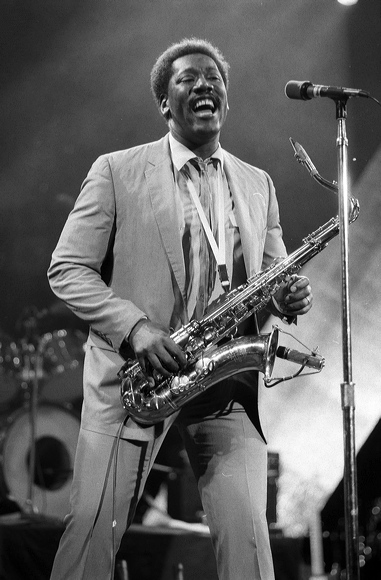
The big black man who played saxophone at that concert died this weekend. His name was Clarence Clemons, although to millions of Springsteen fans he was simply The Big Man. Clarence Clemons wasn’t a great sax player. There are dozens of jazzmen who could school him. And he only really played two great solos in his life. The rest of the time he was content to churn out standard R&B riffs. Don’t let that fool you. He was the heart and soul of the E Street Band, and the E Street Band was the rock ‘n roll band of that nameless generation. Nobody else even came close.

Those two solos are both on the album Born to Run, the album that defined Bruce Springsteen. The first one is on the title track, a mad, soaring slab of soulful exuberance that perfectly matched the grit and passion of the lyrics. “We gotta get out while we’re young,” Bruce Springsteen sang, and that’s what Clarence Clemons played. It was a sax solo for the open road, for busting out and breaking shackles. The second and greater solo occurs at the end of the album, on a song called “Jungleland.” The open road has somehow inexplicably wandered into a thicket of blind alleys. The narrator who set out so confidently on the journey is back on the dead-end streets. Midway through the song Clarence Clemons plays a two-minute solo that captures the sound of America circa 1975, of the nameless generation of kids who thought they might have a defining moment, but didn’t, who busted out only to find a roadblock, a wall, an asphalt jungle without signs or markers. It is a solo that starts with a sustained wail and ends with a whimper. It may be the greatest rock ‘n roll elegy ever captured on recorded media.

That’s the guy who died this weekend. Maybe you had to be there, in Athens, Ohio, on that April night in the mid-1970s. Maybe you simply need to listen to the music. But that’s what we lost. And so it was a strange, rollercoaster day yesterday – Father’s Day, a day where I had wonderful conversations with my wife, and my kids, and numerous friends, and where I found myself emotionally raw, the tears welling up at the strangest times and the most inconvenient moments. The day was great. And so is the loss.